
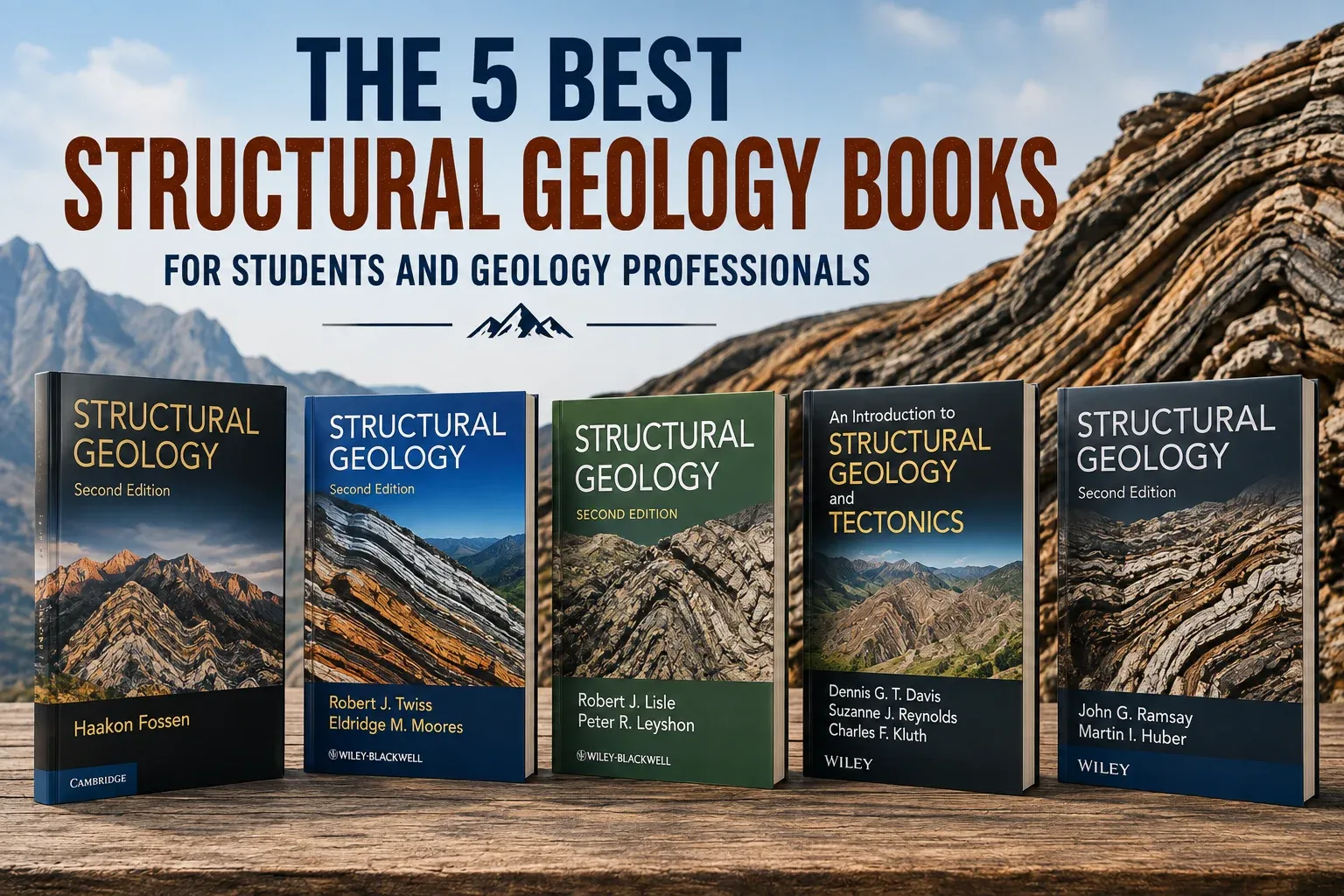
Structural geology is one of the most important branches of geology for understanding how rocks deform and how geological structures such as faults, folds, joints, and shear zones develop. Whether you are a geology student, researcher, field geologist, or simply interested in Earth science, having a good structural geology textbook can make these concepts much easier to understand.
The best structural geology books combine clear explanations with diagrams, real-world examples, mathematical approaches, and practical field applications. However, choosing the right book can be difficult because there are many excellent textbooks available.
In this guide, we have selected 5 of the best structural geology books for students and professionals. These books cover everything from fundamental concepts to advanced structural analysis and tectonics.
1. Structural Geology by Haakon Fossen
Structural Geology by Haakon Fossen is widely regarded as one of the most useful modern textbooks for learning structural geology. It provides a comprehensive introduction to rock deformation and geological structures while maintaining a strong connection between theory and field observations.
The book covers important subjects including stress and strain, brittle and ductile deformation, folds, faults, shear zones, foliations, lineations, and structural analysis.
One of its major strengths is its extensive use of high-quality illustrations. Structural geology can be difficult to understand from text alone, and Fossen’s diagrams help students visualize three-dimensional geological structures.
Why we recommend it
- Clear explanations of complex structural concepts
- Excellent diagrams and illustrations
- Covers both basic and advanced topics
- Useful for undergraduate and graduate students
- Strong connection between theory and geological observations
Best for: Students and readers who want a modern, comprehensive introduction to structural geology.
2. Structural Geology by Robert J. Twiss and Eldridge M. Moores
Structural Geology by Robert J. Twiss and Eldridge M. Moores is another excellent textbook for understanding the physical principles behind geological deformation.
Rather than simply describing structures, the book explores the mechanics responsible for their formation. It introduces concepts such as stress, strain, deformation, rheology, and the behavior of rocks under different physical conditions.
The book is particularly useful for students who want to understand why geological structures form, rather than simply learning how to identify them.
Why we recommend it
- Strong emphasis on geological mechanics
- Detailed treatment of deformation
- Useful for advanced students
- Excellent theoretical foundation
- Helps connect structural observations with physical processes
Best for: Advanced undergraduate and graduate geology students.
3. Structural Geology by Robert J. Lisle and Peter R. Leyshon
Structural Geology by Robert J. Lisle and Peter R. Leyshon is a practical and accessible introduction to structural geology. It is especially useful for students who need help interpreting geological structures and working with geological maps and cross-sections.
The book focuses on practical structural geology skills, making it a valuable companion for field courses and university study.
Topics include geological maps, folds, faults, stereographic projection, structural measurements, and three-dimensional interpretation.
Why we recommend it
- Student-friendly approach
- Strong practical emphasis
- Helpful diagrams
- Useful for geological map interpretation
- Good introduction to structural analysis
Best for: Geology students who want to improve their practical and field-based structural geology skills.
4. An Introduction to Structural Geology and Tectonics by Dennis G. T. Davis, Suzanne J. Reynolds, and Charles F. Kluth
An Introduction to Structural Geology and Tectonics provides a broad overview of structural geology while connecting geological structures to larger tectonic processes.
The book examines how rocks respond to stress and how deformation occurs at different scales. It also connects structures observed in individual rock outcrops with regional tectonic environments.
This broader perspective makes it particularly useful for readers interested in the relationship between structural geology and plate tectonics.
Why we recommend it
- Connects structural geology with tectonics
- Covers deformation at multiple scales
- Useful examples and illustrations
- Suitable for university-level study
- Helps develop geological interpretation skills
Best for: Students who want to understand both structural geology and its tectonic context.
5. Structural Geology by John G. Ramsay and Martin I. Huber
The Techniques of Modern Structural Geology by John G. Ramsay and Martin I. Huber is a classic reference for more advanced students and professional geologists.
The work is particularly valuable for quantitative structural analysis. It provides detailed methods for analyzing geological deformation, including strain analysis, folds, fabrics, and three-dimensional structures.
Although it can be challenging for beginners, it remains an important reference for anyone who wants to go beyond introductory structural geology.
Why we recommend it
- Advanced treatment of structural analysis
- Excellent reference for researchers
- Detailed discussion of deformation and strain
- Useful quantitative approaches
- Valuable for graduate-level study
Best for: Graduate students, researchers, and professional structural geologists.
How to Choose the Best Structural Geology Book
The best book for you depends on your current level and what you want to learn.
For beginners
If you are taking your first structural geology course, choose a textbook with clear explanations and plenty of diagrams. Haakon Fossen’s Structural Geology is an excellent starting point.
For practical field skills
If your goal is to improve geological map interpretation, structural measurements, and field techniques, Lisle and Leyshon’s Structural Geology is a strong choice.
For advanced study
Students studying deformation mechanics and quantitative structural geology may benefit more from Twiss and Moores or Ramsay and Huber.
For structural geology and tectonics
If you want to understand how geological structures relate to regional tectonic processes, An Introduction to Structural Geology and Tectonics is worth considering.
Final Thoughts
Structural geology can initially seem complicated because it requires students to think about rocks and geological structures in three dimensions. The right textbook can make a significant difference by providing clear explanations, useful illustrations, and practical examples.
Our overall recommendation for most students is Structural Geology by Haakon Fossen because it provides a strong balance between fundamental concepts, geological interpretation, illustrations, and modern structural geology.
For more advanced readers, Twiss and Moores and Ramsay and Huber provide deeper treatments of deformation mechanics and structural analysis.
Whichever book you choose, combining textbook study with geological maps, field observations, and practical exercises is one of the best ways to develop a strong understanding of structural geology.
Leave a Reply